
How often should you change your RO filter and membrane?
By the NiskuHelp team · 8 October 2026
The '12 months' printed on an RO purifier's box is a guess. How long its filters last depends on the water going in — and in borewell areas with high TDS and hardness, pre-filters can clog in a few months.
Here is how an RO purifier works, how to tell when each part is due, and whether your water needs RO in the first place. Prices shown are NiskuHelp's live list in Lucknow, as a reference.
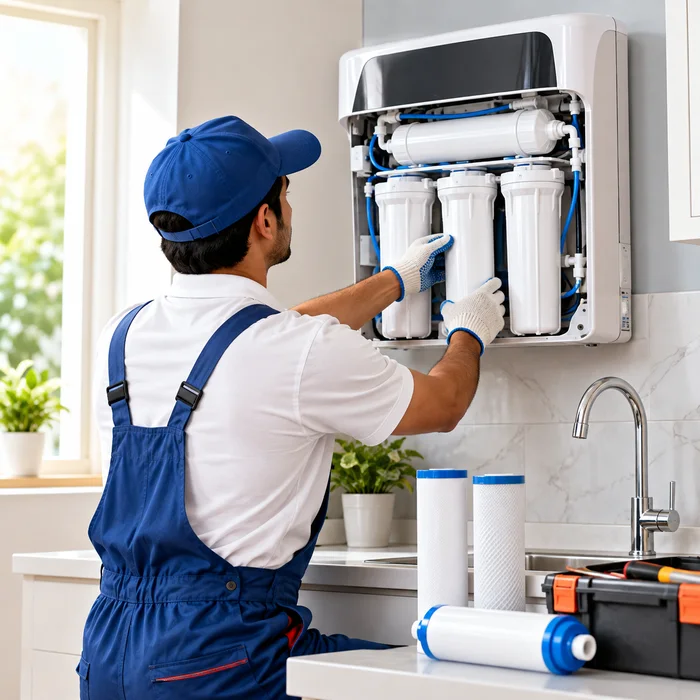
The stages inside a typical RO purifier
Most home purifiers have four to six stages.
- Sediment filter — catches sand, rust and silt; clogs first
- Pre-carbon filter — removes chlorine and odour that would damage the membrane
- RO membrane — removes dissolved salts (TDS), the expensive part
- Post-carbon filter — polishes taste after the storage tank
- UV / UF stage (in some models) — for bacteria and viruses
- Mineral cartridge (in some models) — adds back some minerals
What TDS means, and what the limits are
TDS (total dissolved solids) is the amount of dissolved salts in water, in mg/L or ppm. India's drinking-water standard, BIS IS 10500:2012, sets an acceptable limit of 500 mg/L, and allows up to 2,000 mg/L only where no alternative source exists. A ₹200 TDS meter, or a test by a technician, tells you where your water stands.
Do you even need RO?
If your supply is municipal water with low TDS, a UV or UF purifier may be enough — RO strips minerals and wastes water. RO earns its keep on borewell or tanker water with high TDS or hardness. A test before buying, or before replacing a membrane, saves money.
Signs the filters or membrane are due
Change on symptoms, not only on the calendar.
- Flow slows down or the tank takes much longer to fill
- Taste or smell changes
- TDS of the purified water rises noticeably
- The pump runs longer or makes more noise
- Visible brown colour in the sediment filter
Typical replacement intervals
As a rule of thumb: sediment and pre-carbon filters every 3–6 months, the post-carbon filter every 6–12 months, and the membrane every 1–2 years. High-TDS borewell water shortens all of these; low-TDS municipal water lengthens them.
Real price list (NiskuHelp, Lucknow)
The prices people pay on NiskuHelp in Lucknow today — each professional shows their own price before booking, and spare parts or materials are extra at actual cost.
| RO Basic Service | ₹349per RO | Book |
| RO Deep Service | ₹599per RO | Book |
| RO Cleaning | ₹399per RO | Book |
| RO Sanitization | ₹449per RO | Book |
| RO Performance Check | ₹199per RO | Book |
| Membrane Replacement | ₹1,799per membrane | Book |
| Complete Filter Kit Replacement | ₹1,499per kit | Book |
| Sediment Filter Replacement | ₹299per filter | Book |
| Pre-Carbon Filter Replacement | ₹349per filter | Book |
| Post-Carbon Filter Replacement | ₹349per filter | Book |
| UV Filter Replacement | ₹799per filter | Book |
| UF Filter Replacement | ₹699per filter | Book |
| TDS Check | ₹99per RO | Book |
| Water Quality Check | ₹299per test | Book |
| Leakage Inspection | ₹199per RO | Book |
| RO Performance Inspection | ₹249per RO | Book |
Questions
How often should I change my RO membrane?
Usually every 1–2 years, sooner on high-TDS borewell water. Test the purified water's TDS — a clear rise means the membrane is tired.
What is a safe TDS level for drinking water in India?
BIS IS 10500:2012 gives an acceptable limit of 500 mg/L, and a permissible limit of 2,000 mg/L only where no other source is available.
Is very low TDS water bad?
Very low TDS water tastes flat and lacks minerals; many purifiers have a TDS controller or mineral cartridge to adjust it.
Can I change RO filters myself?
Pre-filters are often simple to change; the membrane and connections are better left to a technician to avoid leaks.
Can I book RO service in Lucknow on NiskuHelp?
Yes — servicing, filter and membrane change, repairs and TDS testing, each with its price, paid after the work.
Prices upfront · pay after the work · professionals near you